
Instantaneous Geyser vs. Traditional Geyser: 2026 Electricity Savings Guide

In 2026, switching to an instantaneous geyser can reduce water-heating electricity costs by 25% to 40% for most South African households. Unlike a traditional geyser that maintains a 150L tank at high temperatures 24/7, an instantaneous water heater only consumes energy when the tap is open. This eliminates "standing heat loss," the primary cause of high utility bills in residential plumbing.
1. Understanding the Current State: The Cost of the Status Quo
Most South Africans are stuck in a "Current State" defined by inefficiency. A traditional storage geyser operates on a thermostat. When the water in the tank drops below a certain temperature, the element switches on—regardless of whether you are home, at work, or asleep. This cycle repeats multiple times a day.
In the context of the Gap Selling methodology, the "pain" here is financial drain. You are paying for thermal energy that dissipates through the tank walls and pipes before it ever reaches your shower head. This "standing loss" is the hidden bottleneck in your home's energy efficiency.
2. What is an Instantaneous Geyser?
An instantaneous geyser, also known as a tankless or "point-of-use" heater, does not store water. Instead, it uses high-powered electric elements or a gas burner to heat cold water as it flows through the unit.
Because there is no tank, the Future State of this technology offers immediate relief from high bills. You only pay for the exact volume of hot water you use.
3. The Direct Comparison: 2026 Data Analysis
Feature | Traditional Storage Geyser (150L) | Instantaneous Water Heater (Electric/Gas) |
Energy Consumption | Continuous (Thermostat cycles) | On-demand only |
Standing Heat Loss | High (Energy lost through tank) | Zero |
Space Required | Large (Horizontal or Vertical tank) | Minimal (Compact wall-mount) |
Water Supply | Limited to tank size | Endless (as long as water flows) |
Typical Lifespan | 8 - 12 Years | 15 - 20 Years |
Monthly Savings | Baseline | 25% - 40% Reduction |
4. Bridging the Gap: How Much Can You Actually Save?
To quantify the impact, we look at the Metrics. If your average monthly electricity bill is R2,500, roughly 40% (R1,000) is dedicated to water heating.
Traditional: R1,000/month.
Instantaneous: R600 - R750/month.
Annual Savings: R3,000 - R4,800.
Over the lifetime of the unit, the LTV (Lifetime Value) of the savings far exceeds the initial CAC (Customer Acquisition Cost) of the hardware and installation.
5. Technical Considerations for South African Homes
While the instantaneous water heater is superior in efficiency, it requires specific Decision Criteria before purchase:
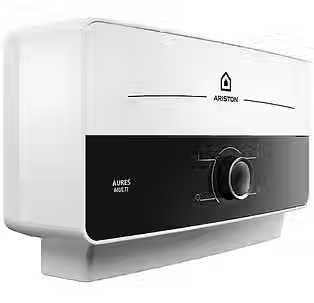
Electric Load: High-capacity electric instantaneous units (like the Ariston Aures) require a dedicated circuit breaker (usually 32A to 40A). Ensure your DB board can handle the peak load.
Flow Rates: For a standard shower, you need a unit capable of delivering at least 10L to 12L per minute. For kitchen basins, 6L per minute is sufficient.
Water Pressure: Most units require a minimum pressure of 1 bar to activate the heating element.
6. Choosing the Best Models for 2026
At Gundo Evolution, we use Data over Opinion to recommend products. Based on durability and after-sales support in South Africa:
Ariston Aures Series: Ideal for luxury bathrooms needing consistent temperatures.
Kwikot Gasmate: The best option for those wanting to bypass load-shedding entirely.
Stiebel Eltron: The premium German choice for high-flow requirements.
7. Conclusion: The Move to an Agile Household
The BMAD Business Method emphasizes "Velocity over Perfection". You don't need a perfect 5-year renovation plan to start saving money. Replacing a single, high-use point (like a kitchen sink or a guest shower) with an instantaneous geyser is a "B+" move that delivers immediate results today.
Are you ready to bridge the gap and stop paying for water you aren't using?

Comments